
Ancestral Leadership and Legacy
- Oct 18, 2017
- 11 min read
Updated: Jun 25, 2022
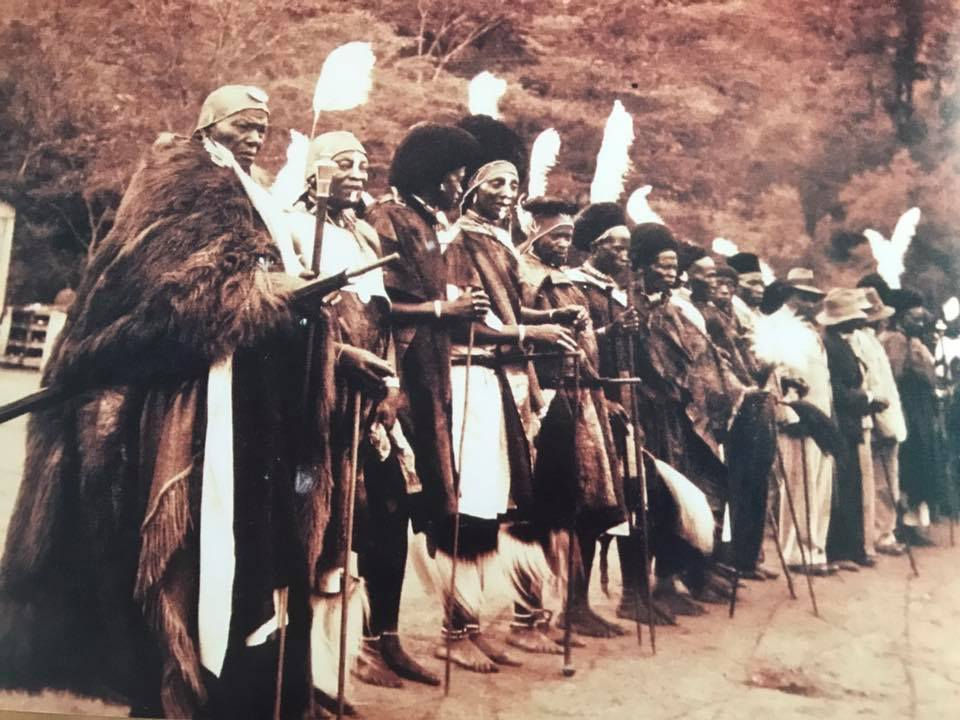
My grandfather, Senior Chief Michuki wa Kagwi (far left)
My journey of Self-discovery drawing upon my ancestral record continues. Two months since my first trip to the archives, I have compiled transcriptions on the subject of my grandfather, Senior Chief Michuki wa Kagwi, with the first record dating back to 1915.
This is my second article on my ancestry and today I am inspired to share my reflections on leadership, especially as Kenyans wait in bewildered anticipation for different facets of leadership in our land to lead for us and not in spite of us. To be fair, the world at large is experiencing similar crises in leadership. The ability of leaders to engage communities and different stakeholders within them and to add value in the lives of those communities is today a rare occurrence. Kenya does not have to be in the same boat as the USA or Spain or Britain. We can and should demonstrate Divine Leadership -- drawing on our inherited ancestral wisdom and our experiential intelligence-- to the rest of the world.
For our leaders, there is now a huge opportunity to be authentic, to be clear about Values, and of course, to have a Vision or what I like to call in my coaching sessions ‘A Big Picture’. It is about working with what you have or -- to put it another way-- the cards you have been dealt: your skills and talents and the reality of the situation. It is about communicating as a human being to other human beings and being inspiring while you are at it, because you yourself are inspired by what you are up to: hence FULFILLMENT. It is about doing what you say you will do and making sure that anybody on your team is a right fit and aligned with your Vision and supported to do their work: PERFORMANCE. This is what people want with the expectation, of course, that leadership is about community and not the individual.
I am going to use my grandfather as an example of a Divine Leader, who blended both the Divine Masculine and the Divine Feminine into his leadership, as did most leaders at that time. I am also going to demonstrate the value of my approach to ‘PERFORMANCE & FULFILLMENT COACHING and how it can be applied to the development of Divine Leadership.
My reference materials for this article are ‘The Southern Kikuyu before 1903 v.I.’, L.S.B Leakey, 2nd Edition, 2007 and documentation from the Kenya National Archives.
To set the context, I shall first delve into certain particularities of ancestral Kikuyu leadership with a caveat: whilst I refer to Kikuyu culture, from which I am descended, I believe that most African tribal cultures held similar ways and beliefs. I am not an anthropologist and so will likely not be researching the ancestral ways of other groups, but I would be delighted to hear where other tribes had similar institutional arrangements or where they differed and if so, how. I think we have so much more in common than colonial and post-colonial systems have led us to believe. My hope in sharing this article is that others will be moved to research and learn more about the fundamental truths of our being and share it in ways we can all relate to and understand so as to empower ourselves with knowledge, inspiration, and possibility. Please share any corrections, thoughts, suggestions, concerns, etc. with me.
Ok, let’s go!
First, let’s understand the structures of leadership that were at play whilst these records were being scribed.
LEADERSHIP
Pre-colonialism
Prior to colonialism and the advent of missionaries in Kikuyu country, there were no chiefs. The system of leadership was essentially ‘for the people and by the people’.
This is how it worked:
1) The Council of Elders
Every village had a ‘kiama’ or a council of elders. These were men selected for their wisdom, understanding in matters of justice, and on many occasions, men who could also administer spiritual rites. The kiama met to deliberate and guide the wishes of their communities and were presided over by a ‘muthamaki’. The muthamaki was considered to be of outstanding intelligence and whilst he could not impose his will over the people, he could influence decisions using his skill of persuasion.
2) The Councils of Warriors
In addition, each village had two councils of younger men made up of appointed warriors from nine different initiation age-groups known as ‘njamas’. There were two categories of njamas- one was made up of warriors from the upper or senior rank of warriors who held a position of power as result of being the eldest age-group initiated into warriorhood and the other was made up of the incoming regiment, or ‘junior class’ of warriors in formation.
As with the kiama, in each of the njamas one or two of the men held the title of ‘muthamaki’. The roles of the muthamaki wa njama of the senior and junior warrior classes were different. The powers conferred to the president of the senior warriors’ council were in relation to military protection, the punishment of theft and witchcraft, general policing and the organization of social gatherings for the village. For the junior class of warriors, the powers conferred were advisory. For the muthamaki wa kiama, the powers conferred were of a judicial nature- dealing with matters of justice and also the dispensation of spiritual rites.
At a wider territorial level, representatives from the village committees were selected, and were led by a muthamaki, usually characterized as a man with considerable influence and exceptional intelligence and authority. If the son of a muthamaki became one himself, it was based on merit and not an inherited birthright.
3) Owner of an Estate
Another level of leadership was by a man who owned a large estate ‘githaka’ and brought together friends and relatives to cultivate it and developed a confined village over which he wielded authority on how people lived on his land, including whether or not individuals could cut down trees or not or remain on his land or not. However, he could not deal with judicial matters, for which the kiama was responsible- unless he was appointed as the muthamaki of the kiama and this was rare.
Post-colonialism
When the British colonialists were setting up their trading centres such as Fort Smith and Fort Hall, they identified and gave certain prominent Kikuyu men authority that they had not held before within their communities. For instance, Chief Waiyaki was the owner of a large estate upon which a village was developed and as such was a man with significant local influence and also a muthamaki of the local council of senior warriors. Europeans who ventured into Kikuyu territory in 1887, 1889 and 1893 (von Hohnel, Frederick Jackson and F.D. Lugard) referred to leaders like Waiyaki as chiefs and therefore the British conferred upon him the status of a chief when they were setting up their administration to take over land and also administer the collection of hut and land tax.
This was a major disruption to the order of things because ‘chiefs’ could only advise their people. Similarly, the members of the wider territorial council of elders were given the titles of district chiefs with the misunderstanding that their authority exceeded reporting back to and advising the communities that appointed them- creating the basis for confusion in leadership as Leakey writes:
“When the people rejected the agreements, the Europeans accused the delegates of treachery and failure to honor and comply with agreements.” p.15
The District Commissioner, a white British colonial administrator stationed at a trading centre e.g. Fort Hall, appointed the headmen and Chiefs within the different locations in Muranga District. Headmen spent time with the chiefs and would socialize with them. The ‘Askari Kanga’ (who wore kangas like a cross-shoulder sheath) were appointed to assist the chief and collecting information such as how much wealth a family had (wives, children, land, animal stock, etc.) and share this information with the chief in a record book. This information would be useful to collect hut and livestock taxes. A District Officer reported to the District Commissioner.
TRANSCRIPTIONS ON SENIOR CHIEF MICHUKI WA KAGWI
So with this background, let’s begin with 2 sets of transcriptions chronologically ordered from the earliest to the last available about my grandfather, of whom I am mighty proud, and who reminds me of my father in so many ways. Where I could not read the writing I have used ‘[ ]’ and will correct this later. The first record is from the Fort Hall District Commissioner’s records: “Fort Hall District Gikuyo or Maragwa-Tana XA1/19/3 DC/FH 4/3” and the second is from the District Officer’s records “Fort Hall District Record Book of Headmen and Senior Chiefs Maragua Tana, XA1/19/3”, both from the Kenya National Archives.
Beginning of 1st record ----
1915: “Michuki is the aptest Headman in Gikuyu, is Karuri’s lieutenant. He has shown his enlightenment [to] planting trees and his desire to build a sundried birch house. His people are in very good order.”
Feb 1915: “Still doing good work. Has just built a school and shows his energy in many ways.”
8th November 1915: “New boundaries established for Michuki’s County on the [Western] border. North side of [Munungu tree] (his old camp) to Waweru wa Mugi. [ ] hence to Muthachio tree in Nyokianga Camp boundaried on the N by the Mathyoya River.
South side of Muranga his in line to Muthachio tree which forms boundary of Chief Muchiri or Jacob terminating where line cuts the Muhungai River.”
30-4-17: “One of the most intelligent and progressive of headmen. Keeps his people in good order and is always ready to do anything to benefit them.”
Feb 1918: “Yes. Michuki ranks with Njiri as a man far above the average intelligence of the Kikuyu race. Evidently rich, evidently powerful and ambitious to rule his country wisely and well.”
If a substitute were ever required for Karuri he would fill the position admirably.
8-6-20: “Michuki still stands out as “the” man in B. Division. His great aim is to be a second Karuri and in walking round his divisions with him I have heard him say, in pointing to the Nyeri Div . – “mpaka wa Wambugo na Michuki” altho there are buffer states between, and B. division is often mentioned by him as “[ranchi] yangu.”
He is a good man and useful to Govt. but strongly disliked by C.M.S. [ ] Neither of his Headmen in much good.
End of 1st record ----
Beginning of 2nd record ----
Michuki Kagwi Location 12
Appointed 1908 under Karuri. Very friendly, ambitious, takes pride in his roads but is apt to be injudicious in sub-divisions other than his own.
1915: “Still doing good work. Energetic.”
1917: “Intelligent, progressive, and keeps his people in good order.”
1918: “Rich, powerful and ambitious to rule wisely and well.”
1921: “A good man, useful to government but strongly disliked by CMS (Christian Missionary Service).”
1925: “Still one of the best men in the District with power and influence undiminished. Inclined to be garrulous &, perhaps, old-fashioned, but knows his own mind and his location is none the worse for his inclination to resist too rapid progress.
1927: “An outstanding personality. An old and tried Govt. servant. Takes a real interest in the progress of education. A land dispute has shaken his hold on his people. Inclined to be too impetuous.
1928: “Very enlightened, energetic, loyal and progressive, with a strong hold on his people. Should be watched over land matters.”
1930: Presented with the Kings Medal for African Certificate of Honor
1933: “Still the outstanding character North of the Maragua. Intensely loyal, conservative over customs, but progressive with matters to do with Education and Agriculture. Astonishing energy, v.ambitious and proud. Too autocratic in land. A very real help to the Administration and meetings.”
10/1935: “Feeling old and garrulous. His advice is sound where he is not directly interested. Extremely loyal and very charming. His people are apt to disregard him because of his increasing years and comparative poverty. Being overshadowed by Muriranja.”
27/2/38: “Still has influence but is too old to do his work efficiently. An effort should be made to get his son Joel, who is a good clerk at Nyeri, to succeed him.”
28.12.39: “Michuki has been diagnosed as suffering from cancer of the stomach. At a baraza held today, it was announced that he had resigned, that his son Joel would be appointed in his stead as soon as he could be spared from his PWD (Public Works Department) duties. Noone showed any inclination to dissent.”
Michuki died 2.1.40
Joel Michuki appointed as from 16.1.40
End of 2nd record ----
I will suspend my admiration for my grandfather and distill these records with the lens of a coach. In this way, I will walk you through my coaching process and show you the outputs that coached leaders have.
COACHING, THE DIVING MASCULINE, AND THE DIVINE FEMININE
As a leader, my grandfather did not lead in isolation. He was the owner of a githaka with over 40 wives, and that alone shows he had numerous coaches! Primarily though, he relied on the Medicineman/woman, the Forseer, his fellow muthamakis and members of the kiama and njamas, and his fellow leaders.
Collectively, Senior Chief Michuki wa Kagwi’s coaches provided both DIVINE MASCULINE and DIVINE FEMININE guidance. What does this mean?
The DIVINE MASCULINE (Soul’s expression of POWER) has the following traits (source: www.soulselfliving.com):
- Honor’s value of own life - Ability to take command of own life - Energy for Accomplishing - Claim Basic Rights to Life - Self confidence - Inner Strength - Dignity - Wise Risk Taking - Decisiveness - Focus - Reason
The above can be compared to unhealthy masculine (WEAKNESS) traits of:
- Low value of Own Life - Angry - Fearful - Intimidated - Bravado - Bragging - Showing Off
The DIVINE FEMININE (Soul’s expression of LOVE) has the following traits (source: www.soulselfliving.com):
- Honor value of lives of others - Allow others to command their own life - Energy for doing what is good - Giving - Selfless - Enthusiasm and zest for life - Persistence- Perseverance - Wise quitting - Kindness- Compassion - Patience - Empathy
The above can be compared to unhealthy feminine (EVIL) traits of:
- Low value on lives of others - Selfish – Greedy - Interfering – Sabotage - Isolated - Withholding - Impatient - Blame - Despair
My grandfather lived at a time when the way people lived was all about Spirituality and roles were selected based on spiritual guidance of Medicine People and Forseers, who connected purpose to the Soul energy (Power, Wisdom, Love, and Courage) – using intuition, nature, and magical powers of divination. They facilitated (NOT controlled) the connection between people and God. (Note: there was a difference between the practice of witchcraft and the practice of divination and the creation of magical possibilities for good and for healing using herbal medicine and rituals. Witchcraft, which was for evil, was punishable by death). So with this guidance, his purpose was understood to be divinely ordained and guided. Also, as a warrior, his initiation processes were largely predicated on the administration of spiritual rites.
As a coach, I can distill that:
1. Michuki wa Kagwi’s BIG PICTURE was (given the reality of colonialism): Progress and empowerment for his people, for which he chose Education, Agriculture, and Roads. All of these were and today continue to be highly empowering in his territory.
2. Michuki wa Kagwi’s VALUES were:
- being enlightened: he build schools, planted trees, built a sundried birch house - being energetic - excellence - intelligence - being progressive - benefiting his people and keeping them in good order - being ambitious - wisdom - power - influence - knowing his own mind - loyalty - maintaining customs - being affable
Can YOU identify Senior Chief Michuki wa Kagwi’s Divine Masculine and Divine Feminine traits?
COACHING TODAY'S LEADERS
Coaching is about self-determination and once you are coached to be self-determining, it follows that the coachee will adapt a similar leadership style. This way of managing people is consistent with the style of leadership applied through kiamas and njamas.
In coaching, we identify your BIG PICTURE and your VALUES (what is valuable to you) and we develop ways to bring your values into congruence with your behavior. Your coach is a creation-collaborator and challenger in YOUR process. Everything that is created comes from within YOU.
So, we establish your GOALS (how you will meet your BIG PICTURE) and we identify the obstacles to meeting those goals and create options for overcoming those obstacles.
Then, we get you into ACTION!
The process is truly magical, because through coaching, you connect with your higher Self (your Divine Masculine and Feminine). We use interventions to generate inspiration and action by tapping into both your left and right brain and your intuition. No two people would be coached in the same way either because what we generate as individuals is different. YOU live more and more within the space of YOUR PURPOSE, hence your sense of FULFILLMENT.
Our leaders need coaches! FULL. STOP.
Also, as I discover more, I am increasingly convinced that we were brainwashed by colonialism and its associated institutions to abandon our highly evolved systems of spiritual leadership on the one hand; and on the other hand we were provided with tools to negotiate our self-determination in an imperial, modernizing, and inter-connecting world.
Collectively, we dropped the ball somewhere. Corruption, value-less politics, low-vibration nonsense in our media, day-in-day-out. I say that we let ourselves down by not organizing ourselves intelligently, using our own systems and remembering that we are spiritual, magical beings with the power to create endless possibilities for all. Perhaps this is the era when we begin again and recall our POWER and LOVE. I hope so.
To be refined and continued...
Copyright Wanja Michuki 2017 www.bbold.co.ke
Comments