
An example of triangulation and sibling position in a family enterprise following death of parents
- Feb 4, 2023
- 5 min read
The work that we do at Be Bold is to apply process and content coaching and consulting to establish what a particular family’s relational structure is across the 3-circle Davis-Taiguri (1982) family enterprise systems, what needs to change, and how to effect the change for results at personal and structural levels. Paired with mapping out the structures that will put these changes in place, through coaching, consulting and facilitation, we empower family members to work together to co-create a strategy that is forward-looking and anticipates multigenerational continuity, evolution, and adaptation.
Triangulation is a theme we explored on our 2nd podcast in our family systems series and is a great way to look at what could be going on in a family system. Lansberg (1999) describes triangulation as “the tendency for a two-person emotional system under stress to form a three-person system”. A third party is brought in to the dynamic as a rescuer and this could go either way- either they help the two-person relationship resolve the cause of anxiety in the relationship, or they make it worse.
When, as in the case of the death of a parent(s), there is a lack of clear leadership or when there is chronic anxiety in the family system, a triangle can occur as in the diagram below:
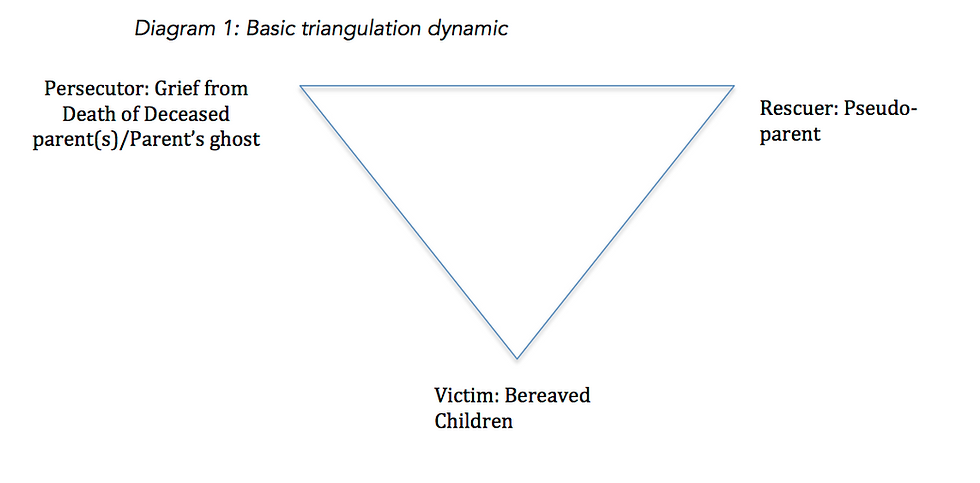
This is an example taking into account sibling position. I think that many readers who are last-born will relate to the roles and dynamic illustrated below with reference to certain aspects of family systems theory. (Most attendees to an event we held at Columbia Global Centers | Nairobi were either last or first borns).
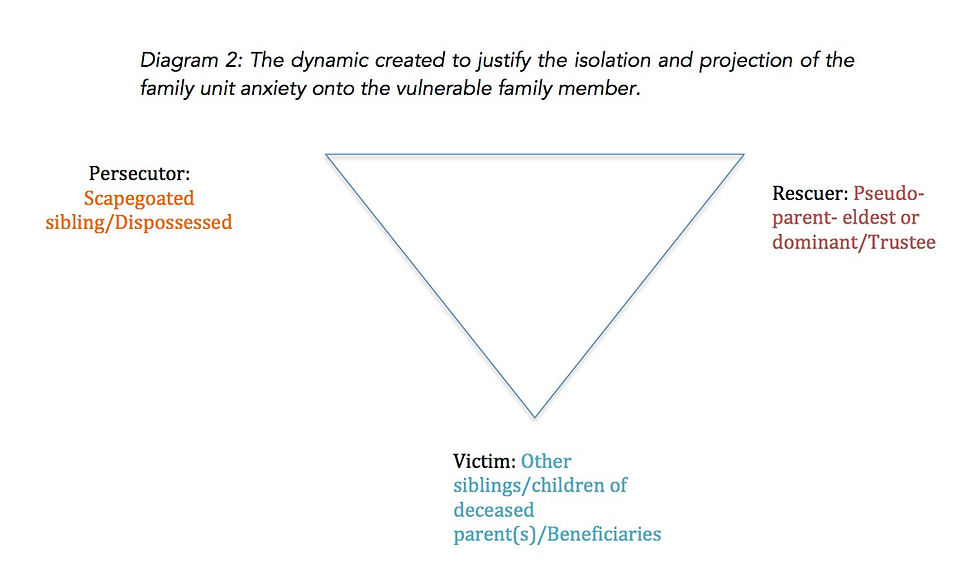
Particularly if there is a wide age gap between the first and last born, or if there is a very dominant bully/aggressive sibling, the first-born or the dominant sibling may subconsciously assume the role of parent(s) following the death of the parent(s), even when all the children are adults. As a way of triangulating the stress of dealing with the death of the parent(s) and in the absence of clear leadership, the pseudo-parental role is forced onto the siblings by the first-born or the dominant sibling. If this role is also accompanied with administratorship or trusteeship, it can be used as a way of coercing compliance and control over the siblings that follow- especially those closer in age to the pseudo-parent as they present a threat to this assumed role. The other threat is presented by defiance or a rejection of this imposed pseudo-parental figure. The last born is likely to follow the lead of the older or dominant sibling unless they have a strong sense of self.
In the language of Family Constellations, this ‘pseudo-parent’ makes other siblings subservient by invoking ‘loyalty’ to the deceased parent, whose shoes they have now stepped into and now attempt to mimic. Rather than allowing family members the space to confront the true impact of the death of their parent(s), they infantilize them.
The compliant siblings also embrace being loyal to the deceased parent through the 'pseudo-parent' at the expense of their true self to avoid processing the anxiety caused by the death and to remain secure in the family system- internally and externally i.e. as perceived by others. Rejection of the new dynamic being established is considered being disloyal to the deceased parent(s), ergo the family system.
The anxiety is not resolved; rather the pseudo-parent and siblings (victims) identify an object to project the anxiety onto- a scapegoat sibling. This is typically the last born, as they are likely to be the most vulnerable in the family system. Through triangulation, the scapegoat role assigned to the most vulnerable is synonymous with being the persecutor. The other siblings will assume the roles of victims and the pseudo-parent will be the rescuer.
Why would the oldest or dominant sibling behave this way in the first place? In his article titled Conflicting Generations: A New Theory of Family Business Rivalry, Jim Grote observes: “When adults fail to find their niche in life or their Dream, they remain like children imitating the actions of the adults who surround them.” In families of wealth, the patriarch or martriarch usually has a large personality- either a very successful businessperson or someone who has built tremendous social capital- in the African context this is usually a formidable figure in business or politics or both.
So, when the children have not been able to self-differentiate from their parents’ Dream, they seek to imitate the dynamic established by and with their deceased parent(s). Rather then see themselves as individuated adults, they subconsciously revert to their roles as children and so accept the elder or dominant sibling as the pseudo-parent. This prolongs the family’s enmeshment and delays self-actualization of its members i.e. enabling family members to actualize their own Dreams. The anxiety of the system persists the more enmeshed the siblings are, and this results in a vicious cycle, until it is recognized for what it is and Healing is brought into the system.
This dynamic can also be created if the eldest siblings holds a subconscious jealousy or envy (again stemming from anxiety) towards the youngest as a result of their belief that the youngest has received more attention than they have from their parent(s) and establishes a mechanism of retribution (isolating the vulnerable sibling) through triangulation. Same-sex older siblings are notorious for this with their younger siblings.
If Healing is not possible or recognized as being necessary, then what is likely to occur is a cut-off, where the scapegoated sibling terminates the relationship with other members of the family due to the discomfort of the projected anxiety, which even external family members may be co-opted into on account of what is now termed as the scapegoats ‘disloyalty’ (persecutor) to the family system i.e. the pseudo-parent (rescuer) and other siblings (victims).
The process of conflict management must be embedded in family enterprises because conflict is inevitable. Due to the high degree of interdependence owing to enterprise and ownership systems keeping family members fused, family enterprises bind families and don’t easily allow for the natural individuation that non-family enterprise families experience outside of their families of origin.
Conflict management is applied through personal, inter-personal, and structural processes and content, and again this is a part of the work that we do through our coaching, consulting, and advisory engagements at Be Bold.
From this example, it should also be clear that governance is a necessary aspect of conflict management. With clear governance structures in which decision-making, accountability, and communication structures are in place, it becomes difficult to isolate a member of the family, for instance if they do not sit on a board, by way of making decisions that are prejudicial to them or by making material decisions without communicating the same to them.
Still, even where boards are in place, there can still be work to do in this area. As an example, a family enterprise may have boards of directors for the holding co. and for subsidiary companies, however by way of voting, the same triangular pattern in the family system can be laid over the enterprise and ownership systems, especially if at the sibling partnership stage, the boards comprise the siblings and do not have voting independent board members. In a situation like this, it is imperative to ensure the voice of the minority sibling is heard, especially if the decision-making structure is based on voting that is not joint. I personally believe that voting on family boards should be joint and especially at the sibling stage, there should be independent non-family directors that also provide specialized input to the enterprise strategy and can bring objectivity to the decision making process where emotional family patterns need to be disrupted.
If a cut-off results in the isolated family member leaving the board, they should still receive information as a result of being a shareholder or a beneficiary and also have forums for engagement such as the AGM or an Owner’s Assembly. Of course a decision to dispossess a sibling and not distribute shares or to present misleading accounts to them is egregious and points to poor stewardship and immorality.
© 2023 Wanja Yvonne Janice Maria Michuki, Be Bold Consulting & Advisory Ltd.
Comments